Thin wall packaging demand is rising with lightweight, cost-efficient, high-speed molded formats for dairy, ready meals, produce, and personal care.
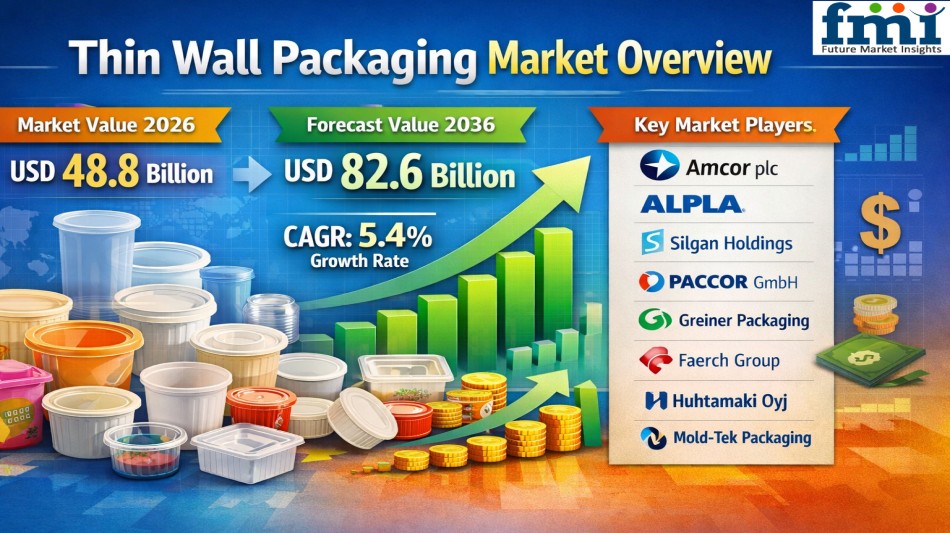
NEWARK, DELAWARE / ACCESS Newswire / March 4, 2026 / The global thin wall packaging market is entering a decade defined by structural expansion, material innovation, and regulatory realignment. Valued at USD 48.8 billion in 2026, the market is projected to reach USD 82.6 billion by 2036, advancing at a CAGR of 5.4%, according to a comprehensive strategic outlook released by Future Market Insights (FMI).
Between 2026 and 2036, the industry is expected to generate an absolute dollar opportunity of USD 33.8 billion, reflecting steady, efficiency-driven growth rather than cyclical volatility. Demand remains closely linked to rising consumption of lightweight, cost-efficient, and high-speed molded packaging formats across dairy, ready-to-eat meals, fresh produce, and personal care applications.
Thin Wall Packaging Market Metrics at a Glance (2026-2036)
Metric |
Value |
|---|---|
Market Value (2026) |
USD 48.8 Billion |
Projected Market Value (2036) |
USD 82.6 Billion |
CAGR (2026-2036) |
5.4% |
Top Growth Market |
India (7.0% CAGR) |
Dominant End Use |
Food & Beverage (51% Share) |
Leading Material |
Polypropylene (40.8% Share) |
Unlock Growth Potential - Request Your Sample Now and Explore Market Opportunities!
https://www.futuremarketinsights.com/reports/sample/rep-gb-24613
The Lightweight Advantage: Efficiency as a Structural Growth Lever
Thin wall packaging refers to lightweight plastic containers manufactured using reduced wall thickness while maintaining structural integrity. These products commonly produced through injection molding and thermoforming-are engineered to minimize resin consumption without compromising durability, food safety compliance, or production speed.
The market's momentum is anchored in three structural pillars:
Lightweighting Economics: Reduced resin usage lowers per-unit material costs while supporting high-volume food categories with tight margin structures.
Processing Efficiency: High-speed injection molding enables rapid cycle times, ensuring compatibility with automated filling lines in dairy, ready meals, and frozen desserts.
Sustainability Alignment: Increasing integration of post-consumer recycled (PCR) content and mono-material polypropylene designs supports circular economy targets.
While demand fundamentals remain strong, resin price volatility and regulatory scrutiny on single-use plastics present ongoing constraints, compelling manufacturers to balance cost optimization with sustainability commitments.
Material Dominance: Polypropylene Leads
Polypropylene (PP) is projected to account for 40.8% of total consumption in 2026, reinforcing its status as the backbone material of thin wall packaging. Its dominance is attributed to:
Excellent stiffness-to-weight ratio
High compatibility with high-speed injection molding
Compliance with stringent food-contact regulations
Strong recyclability profile within mono-material streams
Growing sustainability mandates across Europe and North America are accelerating adoption of PCR-integrated PP solutions, even as manufacturers navigate higher material complexity and certification costs.
Segment Spotlight: Food & Beverage Commands Scale
The Food & Beverage segment is estimated to hold 51% market share in 2026, driven by rising demand for dairy, ready-to-eat meals, confectionery, and fresh produce packaging.
Thin wall formats address key buyer priorities:
Lower transportation costs through weight reduction
Enhanced shelf efficiency via stackable designs
Tamper-evident and secure closure compatibility
Improved storage optimization for organized retail
Urbanization and growing convenience consumption trends continue to anchor this segment's expansion globally.
Regional Growth Engines: Asia Pacific Sets the Pace
India (7.0% CAGR) - The Packaged Food Accelerator
India is projected to lead global growth through 2036, supported by rapid expansion in packaged dairy, sweets, and ready-to-eat food segments. Regulatory enforcement by the Food Safety and Standards Authority of India (FSSAI) has reinforced compliance standards for food-contact plastics, increasing demand for certified PP thin wall containers.
Simultaneously, amendments to India's Plastic Waste Management Rules and Extended Producer Responsibility (EPR) obligations are encouraging recyclable mono-material packaging formats. Government-backed Production Linked Incentive (PLI) schemes for food processing are further strengthening injection-molded container demand.
China (6.5% CAGR) - The High-Volume Processing Hub
China's market growth is underpinned by large-scale food and beverage manufacturing expansion. Regulatory oversight from the State Administration for Market Regulation (SAMR) continues to enforce food-contact material standards, reinforcing packaging compliance.
The country's "dual carbon" strategy and circular economy policies promote lightweighting and material efficiency, favoring thin wall formats across chilled and microwaveable meal categories.
Brazil (6.0% CAGR) - Retail Modernization Momentum
Brazil's expansion is supported by packaged food growth and modernization of retail infrastructure. Oversight by the Brazilian Health Regulatory Agency (ANVISA) continues to reinforce food-contact compliance standards, while the National Solid Waste Policy promotes recyclable packaging adoption.
United States (5.0% CAGR) - Innovation-Led Stability
The U.S. market remains mature yet innovation-driven. Regulatory enforcement under the U.S. Food and Drug Administration (FDA) ensures polymer safety compliance, while state-level EPR legislation in California and Colorado increases emphasis on recyclability and downgauging.
Retail commitments to reduce packaging weight and increase recyclable content further support steady growth in mono-material PP containers.
Germany (4.8% CAGR) - Regulation-Driven Sustainability
Germany's market performance is influenced by the Packaging Act (Verpackungsgesetz) and EU-level regulatory harmonization. The Central Packaging Register has reinforced producer accountability and reporting compliance, encouraging recyclable thin wall designs aligned with the EU Packaging and Packaging Waste Regulation (PPWR).
Competitive Landscape: Scale Meets Sustainability
The thin wall packaging market is moderately consolidated, with multinational rigid plastic packaging leaders operating high-volume injection molding and thermoforming platforms across multiple regions.
Key companies include:
Amcor plc
ALPLA
Silgan Holdings
PACCOR GmbH
Greiner Packaging International
Faerch Group
Huhtamaki Oyj
Mold-Tek Packaging
Plastipak Holdings
Groupe Guillin
Pactiv Evergreen Inc.
Manufacturers with vertically integrated molding operations, in-house tool development, and long-term resin procurement agreements maintain structural advantages. Competitive differentiation increasingly hinges on lightweighting capability, PCR integration, recyclability performance, and automation-driven efficiency.
In April 2025, Amcor plc completed its combination with Berry Global, strengthening its position as a global leader in consumer and healthcare packaging and identifying USD 650 million in synergies.
Meanwhile, in June 2024, Greiner Packaging International expanded r-PET sheet production capacity in Kremsmünster to support circular food packaging solutions across Europe.
Strategic Outlook: Balancing Efficiency and Compliance
FMI analysts observe a transition between conventional virgin polypropylene containers and sustainability-aligned formats incorporating PCR and downgauged designs. While enhanced formats often carry higher input costs, premium labeling and regulatory alignment help offset margin pressures.
Over the next decade, competitive resilience will depend on:
Investment in high-speed injection molding systems
Integration of PCR and bio-based polymers
Long-term supply partnerships with food and FMCG brands
Alignment with evolving EPR and circular economy mandates
As global food systems expand and regulatory frameworks tighten, thin wall packaging is positioned not as a transient trend but as a foundational component of efficient, high-volume consumer goods distribution.
For an in-depth analysis of evolving formulation trends and to access the complete strategic outlook for the Thin Wall Packaging Market through 2036, visit the official report page at: https://www.futuremarketinsights.com/reports/thin-wall-packaging-market
Explore More Research Reports by FMI
Flatbed Die Cutters Market - https://www.futuremarketinsights.com/reports/flatbed-die-cutters-market
United States & Canada Aluminum Tubes Market - https://www.futuremarketinsights.com/reports/united-states-and-canada-aluminum-tubes-market
PCR Plastic Packaging Market - https://www.futuremarketinsights.com/reports/pcr-plastic-packaging-market
Bag On Valve Product Market - https://www.futuremarketinsights.com/reports/bag-on-valve-product-market
Bio-Foam Insert Market - https://www.futuremarketinsights.com/reports/bio-foam-insert-market
About Future Market Insights (FMI)
Future Market Insights (FMI) is a leading provider of market intelligence and consulting services, serving clients in over 150 countries. Headquartered in Delaware, USA, with a global delivery center in India and offices in the UK and UAE, FMI delivers actionable insights to businesses across industries including automotive, technology, consumer products, manufacturing, energy, and chemicals.
An ESOMAR-certified research organization, FMI provides custom and syndicated market reports and consulting services, supporting both Fortune 1,000 companies and SMEs. Its team of 300+ experienced analysts ensures credible, data-driven insights to help clients navigate global markets and identify growth opportunities.
For Press & Corporate Inquiries
Rahul Singh
AVP - Marketing and Growth Strategy
Future Market Insights, Inc.
+91 8600020075
For Sales - sales@futuremarketinsights.com
For Media - Rahul.singh@futuremarketinsights.com
For web - https://www.futuremarketinsights.com/
SOURCE: Future Market Insights, Inc.
View the original press release on ACCESS Newswire