Plant-based food market enters high-growth phase driven by health, sustainability, price parity efforts, fermentation innovation, and global mainstream adoption.
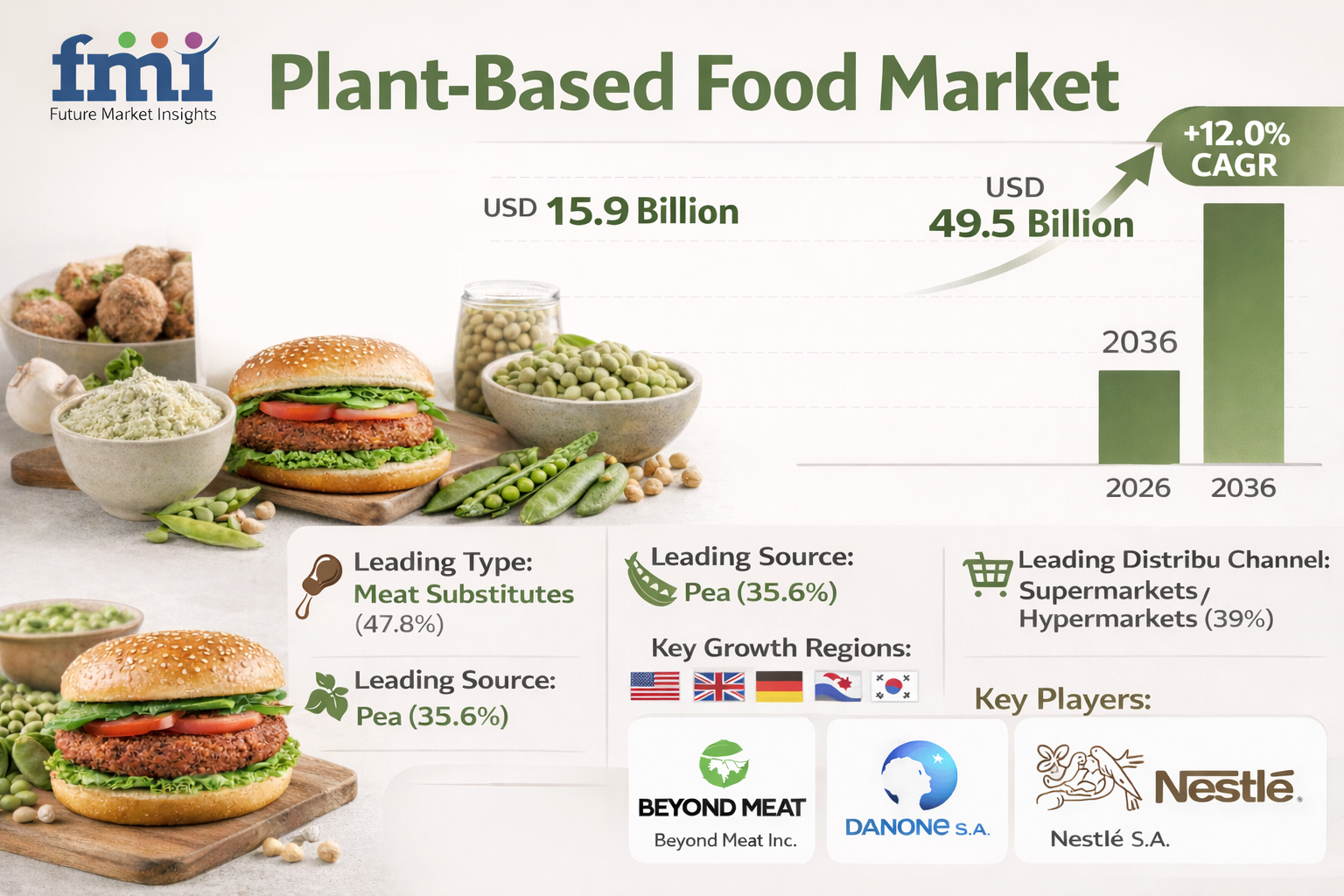
NEWARK, DELAWARE / ACCESS Newswire / March 4, 2026 / The global plant-based food industry is entering a decisive second growth cycle. What began as a niche sustainability movement has matured into a structured, capital-intensive food transformation. Valued at USD 15.9 billion in 2026, the Plant-Based Food Market is forecast to surge to USD 49.5 billion by 2036, registering a powerful CAGR of 12.0%, according to Future Market Insights (FMI).
This acceleration reflects more than consumer curiosity. It signals structural normalization. The U.S. retail plant-based sector alone reached USD 8.1 billion in 2024, demonstrating long-term category resilience and household penetration across 59% of American homes, as reported by the Plant Based Foods Association (PBFA).
Quick Market Snapshot (2026-2036)
Market Value (2026): USD 15.9 Billion
Market Value (2036): USD 49.5 Billion
CAGR: 12.0%
Leading Type: Meat Substitutes (47.8%)
Leading Source: Pea Protein (35.6%)
Leading Channel: Supermarkets/Hypermarkets (39%)
Key Growth Regions: USA, UK, Germany, South Korea
Request Your Sample Now and Explore Market Opportunities! https://www.futuremarketinsights.com/reports/sample/rep-gb-14823
From Hype to High-Volume Economics
The next decade will not be defined by viral product launches but by margin discipline, price parity, and scalable infrastructure. Early trial rates have stabilized. Now, the industry's mandate is clear: achieve cost competitiveness with conventional proteins while maintaining clean-label credentials and taste fidelity.
"Alternative proteins are agricultural innovations that, with proper levels of government and private support, will help ensure planetary and public health," noted Caroline Bushnell, SVP of Corporate Engagement at the Good Food Institute in April 2024.
The primary growth driver remains the convergence of health consciousness and climate accountability. Nearly three-quarters of U.S. consumers report openness to plant-based options, while 18% actively reduced meat intake as of 2025. Scope 3 emission reduction mandates across global corporations are further accelerating institutional procurement of plant proteins.
Financial Discipline Becomes Competitive Advantage
The plant-based sector is shifting from "land grab" expansion to operational efficiency. Three financial metrics are reshaping boardroom strategy:
Gross Margin Parity:
Achieving the 20-30% gross margin benchmark typical of conventional meat remains the industry's "holy grail." Scale is critical. The 2025 opening of a shared production facility by Planteneers in Illinois exemplifies how shared infrastructure reduces fixed costs and improves unit economics.
Inventory Turnover:
Fresh meat analogues carry higher spoilage risks. Brands are rationalizing SKUs and expanding frozen and shelf-stable formats to enhance cash flow efficiency.
Debt-to-Equity Balance:
As venture capital tightens, established conglomerates such as Nestlé S.A. and Tyson Foods Inc. benefit from balance sheet strength, sustaining longer R&D cycles. Pure-play startups face consolidation pressures in a capital-constrained environment.
Segmentation: Where the Real Opportunity Lies
Why Meat Substitutes Dominate
Meat substitutes command 47.8% of total market share, driven by the ubiquity of burger and sausage analogues in retail and food service. Early success stemmed from replicating the "sizzle and bleed" experience that resonated with flexitarians.
However, the next opportunity lies in whole-cut analogues, seafood alternatives, and fermentation-enabled dairy replication-segments addressing texture and sensory complexity gaps.
Why Pea Protein Leads
Pea protein holds a 35.6% share, surpassing soy in many new formulations. Its non-GMO positioning and low allergenicity align with clean-label demands. Manufacturers are expanding acreage and diversifying into mycelium, fava bean, and algae to reduce ingredient concentration risk and improve mouthfeel.
Supply chain diversification is now a strategic necessity rather than optional innovation.
Regional Performance: A Multi-Speed Expansion
United States (12.6% CAGR)
The U.S. represents the global pivot point. After a period of volume stagnation, consolidation is clearing underperforming brands. The market is transitioning toward "version 3.0" products focused on nutrition density and price competitiveness.
United Kingdom (11.4% CAGR)
Despite cost-of-living pressures, plant-based milk and hybrid meals are stabilizing volumes. The UK remains a retail innovation testbed for value-tier launches and vegetable-forward hybridization strategies.
Germany (12.0% CAGR)
Germany stands as Europe's innovation hub, supported by progressive environmental policy and high vegan adoption. With USD 1.2 billion in protein ingredient imports in 2023, it functions as a continental processing center.
South Korea (12.2% CAGR)
Government-backed Food Tech initiatives and trend-sensitive demographics are propelling rapid expansion. Localized adaptations-such as vegan kimbap and kimchi-demonstrate how plant-based integrates seamlessly into traditional cuisines.
M&A and the Fermentation Frontier
Strategic consolidation is accelerating technology transfer from biotech to food. In August 2024, Mars, Incorporated acquired Kellanova for USD 35.9 billion-creating a snacking powerhouse with deep fermentation R&D capabilities.
Simultaneously, ingredient innovation partnerships are multiplying. Companies are prioritizing proprietary fermentation processes capable of delivering authentic cheese stretch and fibrous meat textures.
The competitive battleground is shifting from supermarket shelves to bioreactors.
Food Service: The Critical Trial Engine
Food service remains the industry's primary adoption catalyst. Plant-based center-plate options in quick-service restaurants, schools, hospitals, and public procurement programs reduce consumer hesitation and normalize consumption habits among younger demographics.
Institutional demand provides stable base-load volume, insulating the industry from retail volatility.
Competitive Landscape: Scale Meets Intellectual Property
The sector features established innovators including:
Amy's Kitchen
Danone S.A.
Beyond Meat Inc.
Impossible Foods Inc.
Nestlé S.A.
Tyson Foods Inc.
The industry is entering a "capacity rationalization" phase. Highly automated production hubs are replacing inefficient facilities, lowering per-unit costs and raising entry barriers.
Intellectual property in texture science, fermentation precision, and protein structuring will define market leadership.
Outlook: From Alternative to Default
By 2036, plant-based proteins will no longer be marketed as alternatives. They will be embedded as standard protein options across retail, food service, and institutional catering.
The convergence of health optimization, climate imperatives, and food security policy creates structural demand beyond consumer fads. The industry's evolution from startup-driven experimentation to industrial-scale manufacturing marks a defining decade ahead.
For an in-depth analysis of evolving formulation trends and to access the complete strategic outlook for the Plant-Based Food Market through 2036, Full Report Request - https://www.futuremarketinsights.com/reports/plant-based-food-market
Related Reports:
Plant-Based Pet Food Market: https://www.futuremarketinsights.com/reports/plant-based-pet-food-market
Plant-Based Protein Market: https://www.futuremarketinsights.com/reports/plant-based-protein-market
Plant-Based Ice Creams Market: https://www.futuremarketinsights.com/reports/plant-based-ice-creams-market
Plant-based Milk Market: https://www.futuremarketinsights.com/reports/plant-based-milk-market
Plant-based Snacks Market: https://www.futuremarketinsights.com/reports/plant-based-snacks-market
About Future Market Insights (FMI)
Future Market Insights (FMI) is a leading provider of market intelligence and consulting services, serving clients in over 150 countries. Headquartered in Delaware, USA, with a global delivery center in India and offices in the UK and UAE, FMI delivers actionable insights to businesses across industries including automotive, technology, consumer products, manufacturing, energy, and chemicals.
An ESOMAR-certified research organization, FMI provides custom and syndicated market reports and consulting services, supporting both Fortune 1,000 companies and SMEs. Its team of 300+ experienced analysts ensures credible, data-driven insights to help clients navigate global markets and identify growth opportunities.
For Press & Corporate Inquiries
Rahul Singh
AVP - Marketing and Growth Strategy
Future Market Insights, Inc.
+91 8600020075
For Sales - sales@futuremarketinsights.com
For Media - Rahul.singh@futuremarketinsights.com
For web - https://www.futuremarketinsights.com/
SOURCE: Future Market Insights, Inc.
View the original press release on ACCESS Newswire