Driven by renewable integration, high-voltage expansion, and next-generation polymer innovation across global power grids
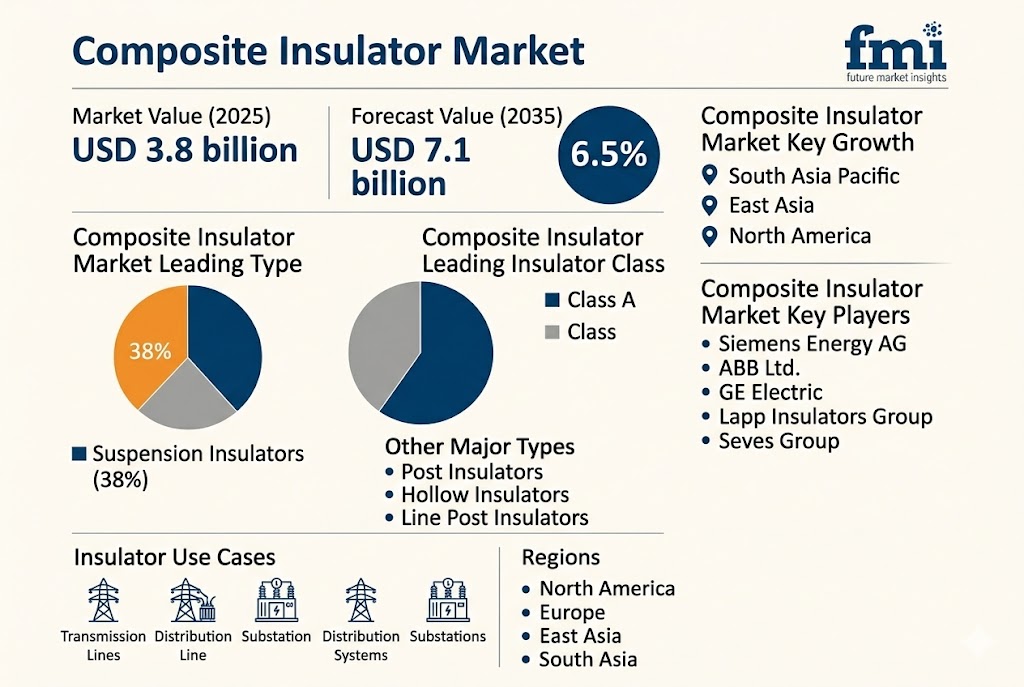
NEWARK, DELAWARE / ACCESS Newswire / March 4, 2026 / The global composite insulator market is entering a decisive growth phase, driven by large-scale grid modernization, renewable energy integration, and high-voltage transmission expansion. The market is projected to grow from USD 3.8 billion in 2025 to USD 7.1 billion by 2035, registering a steady CAGR of 6.5% over the forecast period.
According to the latest analysis by Future Market Insights (FMI), composite insulators are rapidly replacing traditional porcelain systems as utilities prioritize lightweight, high-performance, and contamination-resistant solutions across transmission and distribution infrastructure.
Get Access of Report Sample: https://www.futuremarketinsights.com/reports/sample/rep-gb-14359
Market Snapshot (2025-2035)
Metric |
Value |
|---|---|
Market Value (2025) |
USD 3.8 Billion |
Forecast Value (2035) |
USD 7.1 Billion |
CAGR (2025-2035) |
6.5% |
Leading Product Type |
Suspension Insulators (38% Share) |
Leading End Use |
Utilities (58% Share) |
High-Growth Regions |
South Asia Pacific, East Asia, North America |
A Decade of Structural Grid Transformation
The first half of the decade (2025-2030) will see the market expand from USD 3.8 billion to USD 5.2 billion, adding USD 1.4 billion and accounting for 42% of total forecast growth. This phase is characterized by the transition from legacy porcelain insulators to polymer-based composite systems offering superior electrical performance and durability.
Between 2030 and 2035, the market will accelerate further to reach USD 7.1 billion, adding USD 1.9 billion and representing 58% of total expansion. This period will be defined by smart grid integration, IoT-enabled monitoring, and ultra-high voltage deployment.
Why Composite Insulators Are Replacing Conventional Systems
Composite insulators offer several technical and operational advantages:
Lightweight design reduces structural load on transmission towers
Superior hydrophobic properties enhance performance in polluted or coastal environments
High mechanical strength supports ultra-high voltage transmission
Lower maintenance requirements compared to porcelain alternatives
Utilities are increasingly adopting these systems to enhance grid resilience while reducing lifecycle costs.
Segmental Leadership: Suspension and Medium Voltage Dominate
By Product Type
Suspension insulators lead the market with a 38% share, driven by extensive deployment across high-voltage transmission lines and substation upgrades.
By Voltage Type
Medium voltage systems hold a 37% share due to their widespread application in distribution and transmission networks.
By Rating
The 11kV to 200kV segment commands 33% market share, favored for its reliability and adaptability across industrial and utility environments.
By End Use
Utilities dominate with 58% market share, reflecting strong demand for transmission optimization and infrastructure expansion.
Regional Outlook: Asia and Europe Set the Pace
China (7.5% CAGR)
China remains a growth powerhouse, supported by aggressive infrastructure programs and renewable integration initiatives. Major industrial hubs like Shanghai and Guangdong are witnessing large-scale composite insulator adoption across transmission corridors.
United Kingdom (10.3% CAGR)
The UK emerges as the fastest-growing developed market, propelled by renewable energy projects and offshore wind transmission investments.
Germany (5.9% CAGR)
Germany maintains leadership in Europe, driven by mature electrical regulations and advanced transmission infrastructure modernization.
United States (5.7% CAGR)
The U.S. market benefits from engineering innovation and high-voltage investment across states such as California and Texas.
Japan (5.0% CAGR)
Japan's growth reflects grid upgrades and increased focus on efficient voltage control systems.
European Market Breakdown (2025-2035)
The European composite insulator market is expected to grow from USD 950 million in 2025 to USD 1.8 billion by 2035, at a CAGR of 6.6%.
Germany: 26.4% market share
United Kingdom: 20.8%
France: 17.3%
Italy: 13.9%
Spain: 10.2%
Poland: 8.1%
Emerging adoption across Nordic and Eastern European countries will further support expansion.
Opportunity Pathways: USD 3.3 Billion Value Creation
The market will generate USD 3.3 billion in incremental value between 2025 and 2035. Key opportunity clusters include:
Advanced suspension insulator systems
South Asian grid expansion programs
High-voltage precision transmission solutions
Renewable energy integration platforms
IoT-enabled smart grid monitoring systems
Advanced polymer material development
Market Drivers and Constraints
Growth Drivers
Grid modernization initiatives
Rising renewable energy capacity
High-voltage transmission expansion
Infrastructure electrification in emerging markets
Key Restraints
Volatility in polymer raw material costs
High initial equipment investment
Performance limitations in extreme environmental conditions
Compatibility concerns with legacy infrastructure
Competitive Landscape: Innovation Defines Leadership
The composite insulator market features moderate concentration, with 20-25 active global participants.
Market Leaders
Siemens Energy AG
ABB Ltd.
GE Electric
These companies leverage strong R&D capabilities and global utility partnerships to maintain premium positioning.
Technology Innovators
Lapp Insulators Group
Seves Group
BHEL
Regional Specialists
Maclean Power Systems
Olectra Greentech Limited
TE Connectivity
Hitachi Energy Ltd.
Competition increasingly centers on polymer innovation, voltage optimization, and digital grid compatibility rather than price-based rivalry.
Outlook to 2035: From Component to Critical Infrastructure
By 2035, composite insulators will evolve from specialized equipment to mission-critical grid components. As renewable penetration deepens and electrification accelerates across industries, utilities will rely on advanced insulation technologies to ensure transmission stability, operational efficiency, and long-term reliability.
The trajectory toward USD 7.1 billion underscores a broader transformation: composite insulators are becoming foundational to next-generation power infrastructure worldwide.
For an in-depth analysis of evolving formulation trends and to access the complete strategic outlook for the Composite Insulator Market through 2035, Full Report Request: https://www.futuremarketinsights.com/reports/composite-insulators-market
Related Reports:
Composite Roller Market- https://www.futuremarketinsights.com/reports/composite-rollers-market
Dredging Equipment Market- https://www.futuremarketinsights.com/reports/dredging-equipment-market
Laser Vibrometer Market- https://www.futuremarketinsights.com/reports/laser-vibrometer-market
About Future Market Insights (FMI)
Future Market Insights (FMI) is a leading provider of market intelligence and consulting services, serving clients in over 150 countries. Headquartered in Delaware, USA, with a global delivery center in India and offices in the UK and UAE, FMI delivers actionable insights to businesses across industries including automotive, technology, consumer products, manufacturing, energy, and chemicals.
An ESOMAR-certified research organization, FMI provides custom and syndicated market reports and consulting services, supporting both Fortune 1,000 companies and SMEs. Its team of 300+ experienced analysts ensures credible, data-driven insights to help clients navigate global markets and identify growth opportunities.
For Press & Corporate Inquiries
Rahul Singh
AVP - Marketing and Growth Strategy
Future Market Insights, Inc.
+91 8600020075
For Sales - sales@futuremarketinsights.com
For Media - Rahul.singh@futuremarketinsights.com
For web - https://www.futuremarketinsights.com/
SOURCE: Future Market Insights, Inc.
View the original press release on ACCESS Newswire