Natural food colors market grows as clean-label reformulation, ingredient scrutiny, and demand for plant-based color systems reshape food manufacturing globally.
NEWARK, DE / ACCESS Newswire / March 12, 2026 / Future Market Insights (FMI) projects that the global Natural Food Colors Market is entering a new phase of expansion as food manufacturers increasingly reformulate products to meet clean-label expectations and stricter ingredient scrutiny. As brands seek to balance visual appeal with recognizable ingredients, natural color systems are gaining importance across beverages, dairy, confectionery, and processed foods.
The natural food colors market is expected to witness steady growth over the forecast period, reaching an estimated value of USD 4.4 billion by 2036. This expansion is driven by rising consumer demand for clean-label products and naturally derived ingredients in food and beverages. The market is projected to grow at a compound annual growth rate (CAGR) of 7.3% between 2026 and 2036, reflecting the increasing shift away from synthetic additives toward natural alternatives.
Industry assessments suggest that demand will remain firmly supported through the 2026-2036 period as regulatory frameworks, consumer awareness, and product innovation push food manufacturers toward nature-derived color solutions.
Discover Growth Opportunities in the Market - Get Your Sample Report Now: https://www.futuremarketinsights.com/reports/sample/rep-gb-35
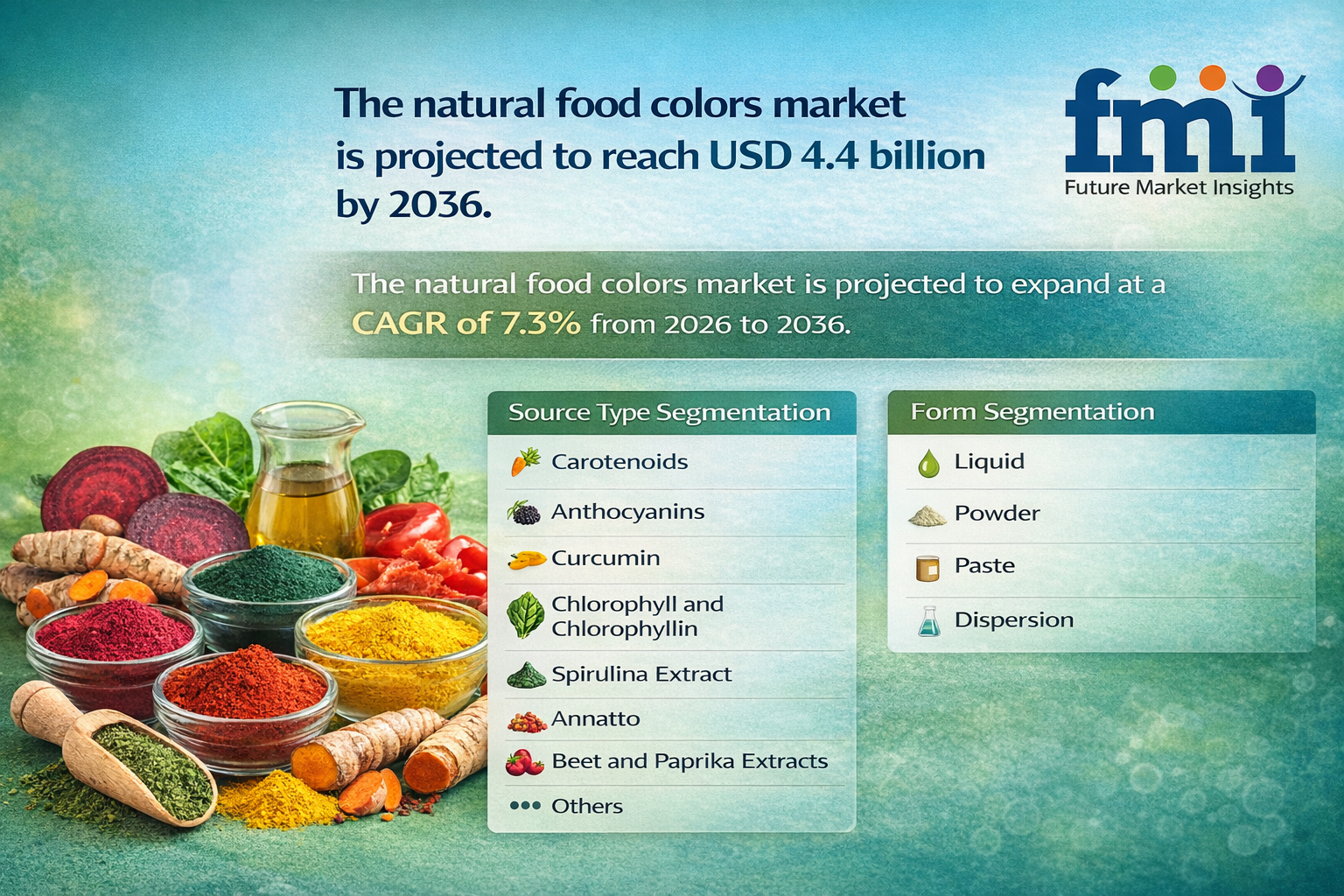
Natural Food Colors Market Snapshot
Leading Source Type: Carotenoids (36.0% share in 2026)
Top Form Segment: Liquid formats (54.4% revenue share in 2026)
Largest Application: Beverages (38.8% demand share in 2026)
Largest Regional Market: Europe
Fastest Growing Region: South Asia Pacific (2026-2036)
Rising Demand for Clean-Label Ingredient Systems
The natural food colors market is being shaped by a global shift toward ingredient transparency. Food manufacturers are increasingly reformulating products to reduce reliance on synthetic dyes while maintaining strong visual identity.
Public regulatory frameworks across regions such as the United States and European Union maintain strict authorization and labeling requirements for food colorants. As a result, brands are under constant scrutiny regarding ingredient declarations, encouraging a gradual migration toward botanical-derived color systems.
At the same time, rising production of packaged foods-including beverages, snacks, dairy products, and confectionery-continues to create recurring demand for standardized and scalable color solutions. Larger food manufacturing ecosystems require color ingredients that deliver consistent shades, stable performance, and regulatory clarity across multiple markets.
Supply Chain Dynamics Influence Pricing and Adoption
Natural food colors rely on agricultural or biological feedstocks such as beet, paprika, carrot extracts, and spirulina. Unlike synthetic colorants, these inputs are sensitive to agricultural output, postharvest handling, storage quality, and extraction efficiency.
Variability in these supply chains can influence pricing and product availability. When high-quality feedstocks become constrained, the cost of producing application-ready color systems increases. In certain pigment families-particularly natural blue systems derived from spirulina-controlled biological cultivation is necessary, further shaping supply dynamics.
As a result, the market often experiences periods where qualified supply becomes a premium asset. In these conditions, manufacturers prioritize suppliers that can ensure consistent pigment stability, processing resilience, and regulatory compliance.
Carotenoids Lead the Source Mix
Among natural pigment families, carotenoids remain the dominant source type and are projected to account for 36.0% of global market value in 2026.
Their leading position stems from broad commercial usability. Carotenoid-based systems provide reliable yellow-to-orange shades and perform effectively across large-scale applications such as beverages and dairy products. Additionally, their supply chains are relatively mature compared with more technically challenging alternatives.
Other pigment families-including anthocyanins, annatto, and spirulina extracts-continue to play important roles but often require more precise formulation management due to variations in pH stability, heat tolerance, and light sensitivity.
Liquid Formats Dominate Industrial Workflows
By form, liquid natural food colors are projected to account for 54.4% of global revenue in 2026, reflecting how large-scale food manufacturers integrate color systems into production lines.
Liquid systems offer several operational advantages:
Accurate dosing during high-volume manufacturing
Better dispersion in beverage and dairy formulations
Improved mixing consistency in sauces and ready meals
Powder formats remain commercially important due to longer shelf life and easier transportation. However, they are less dominant in applications where inline manufacturing convenience and rapid dispersion are critical.
Beverage Industry Drives Demand
The beverage sector is expected to remain the largest application segment, accounting for 38.8% of demand in 2026.
Beverage manufacturing combines large production volumes with strict requirements for shade consistency and stability. Natural colors used in drinks must maintain visual integrity despite challenges such as acidity, light exposure, and long shelf life.
Beyond beverages, dairy and frozen desserts also represent strong demand centers because color plays a role in flavor signaling and product standardization. Confectionery and bakery applications continue to generate usage where seasonal launches and visual differentiation drive ingredient demand.
Regional Outlook: Two-Speed Market Dynamics
Geographically, the natural food colors market reflects a two-speed growth pattern. Mature regions maintain scale and formulation depth, while emerging markets expand the long-term opportunity pool as packaged-food production accelerates.
Regional Growth Comparison (2026-2036)
Region |
CAGR 2026-2036 |
|---|---|
South Asia Pacific |
8.3% |
Latin America |
7.9% |
East Asia |
7.6% |
Middle East & Africa |
7.2% |
North America |
6.9% |
Europe |
6.5% |
Europe remains the largest regional market due to its strong food-and-drink manufacturing ecosystem and rigorous ingredient scrutiny. Meanwhile, South Asia Pacific is expected to record the fastest expansion as packaged food production grows across countries such as India and parts of Southeast Asia.
In North America, demand remains steady due to strong branded-food production and continued reformulation toward cleaner ingredient declarations.
Market Outlook: Performance Matters as Much as Origin
The natural food colors market is supported by strong structural drivers, including regulatory scrutiny, clean-label positioning, and expanding packaged-food production. However, adoption economics vary significantly depending on pigment family and application.
Natural colors succeed commercially when they deliver both visual impact and technical performance under real manufacturing conditions. Stability in acidic beverages, resistance to heat processing, and reliable supply chains are often more decisive factors than botanical origin alone.
As the industry evolves, suppliers that combine agronomic sourcing, extraction capability, application expertise, and regulatory knowledge are expected to lead the next phase of growth.
Competitive Landscape
The natural food colors market features a competitive mix of global ingredient suppliers and specialized color technology companies. Key participants include:
Givaudan
Sensient Technologies Corporation
Oterra
dsm‑firmenich
DDW The Color House
Archer Daniels Midland Company
Kalsec Inc.
Döhler Group
ROHA Group
These companies continue to invest in botanical extraction technologies, formulation support, and supply-chain resilience to meet the evolving requirements of food manufacturers worldwide.
For an in-depth analysis of evolving formulation trends and to access the complete strategic outlook for the Natural Food Colors Market through 2036, Full Report Request - https://www.futuremarketinsights.com/reports/global-natural-food-colours-market
Related Reports:
Natural Food Flavors Market: https://www.futuremarketinsights.com/reports/natural-food-flavors-market
ASEAN Natural Food Color Market: https://www.futuremarketinsights.com/reports/asean-natural-food-color-market
Caramel Food Colors Market: https://www.futuremarketinsights.com/reports/caramel-food-colors-market
Lycopene Food Colors Market: https://www.futuremarketinsights.com/reports/lycopene-food-colors-market
About Future Market Insights (FMI)
Future Market Insights (FMI) is a leading provider of market intelligence and consulting services, serving clients in over 150 countries. Headquartered in Delaware, USA, with a global delivery center in India and offices in the UK and UAE, FMI delivers actionable insights to businesses across industries including automotive, technology, consumer products, manufacturing, energy, and chemicals.
An ESOMAR-certified research organization, FMI provides custom and syndicated market reports and consulting services, supporting both Fortune 1,000 companies and SMEs. Its team of 300+ experienced analysts ensures credible, data-driven insights to help clients navigate global markets and identify growth opportunities.
For Press & Corporate Inquiries
Rahul Singh
AVP - Marketing and Growth Strategy
Future Market Insights, Inc.
+91 8600020075
For Sales - sales@futuremarketinsights.com
For Media - Rahul.singh@futuremarketinsights.com
For web - https://www.futuremarketinsights.com/
SOURCE: Future Market Insights, Inc.
View the original press release on ACCESS Newswire