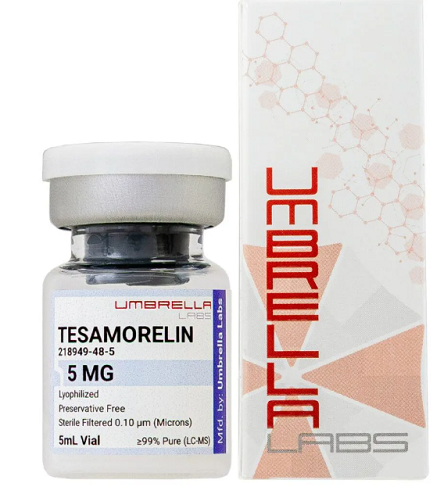
TUCSON, AZ / ACCESS Newswire / February 19, 2026 / Umbrella Labs today announced expanded research procurement availability of tesamorelin in lyophilized vial format to support laboratories building reproducible, documentation forward studies in GHRH receptor signaling and growth hormone axis modeling. The program is designed for assay developers and research teams that require traceable sourcing, stable specifications, and consistent handling expectations across multi run experimental timelines.
Tesamorelin is increasingly used as a laboratory tool when investigators need a GHRH analog reference material that can be applied consistently across receptor pharmacology assays, secretome profiling, and downstream endocrine signaling readouts under controlled bench conditions. Research procurement teams that prioritize stable catalog references and repeat ordering discipline can align internal records around the Umbrella Labs tesamorelin listing, which is presented in the peptide vial catalog as https://umbrellalabs.is/shop/peptides/peptide-vials/tesamorelin-2mg-vial/ and structured to support inventory continuity across study phases. The listing reflects a lyophilized format with defined vial size options and specification fields that laboratories can log directly into inventory systems, method documentation, and LIMS workflows for reproducible comparisons across time. This program is sold strictly for laboratory developmental research use only and is intended for qualified research environments using established institutional procedures for biochemical reagents, documentation, and handling.
Current bench science in endocrine signaling increasingly connects receptor proximal measurements to systems level outcomes, including transcriptional state shifts, metabolic pathway signatures, and time resolved secreted factor dynamics in model systems. Tesamorelin supports this kind of work as an experimental probe for GHRH receptor mediated signaling, enabling laboratories to compare pathway engagement under matched conditions and to validate whether observed changes reflect biology rather than preparation drift. Umbrella Labs is positioning tesamorelin procurement and documentation so teams can scale from early assay validation to multi week replication cycles without changing sourcing conventions or recordkeeping structure.
RESEARCH CONTEXT, GHRH RECEPTOR BIOLOGY, AND WHY TESAMORELIN IS A PRACTICAL BENCH TOOL
GHRH receptor signaling sits at an intersection of hypothalamic peptide signaling, pituitary secretory dynamics, and broader endocrine feedback logic that shapes downstream metabolic programs in many model systems. In bench research, this axis is often studied as a coordinated network rather than as a single receptor event, because receptor activation can influence downstream secretion patterns, transcriptional programs, and secondary signaling cascades that evolve across minutes, hours, and longer windows. For laboratories, a reliable GHRH analog tool can simplify experimental design by providing a consistent reference perturbation to test receptor coupling, secretory dynamics, and downstream signaling outputs under standardized assay conditions.
Tesamorelin is described in the research literature as a 44 amino acid GHRH analog engineered for improved stability relative to endogenous GHRH, making it useful for experimental settings where consistent exposure and reproducible receptor engagement are central to interpretation. In receptor and secretory studies, stability matters because short lived ligands can create variable apparent potency or timing effects if exposure changes during the assay window. A stability optimized analog supports timecourse work where endpoints depend on precise timing, consistent working solution assumptions, and repeatable handling across runs.
A second reason tesamorelin is used in research is that it enables controlled interrogation of GHRH receptor activation without directly substituting downstream hormones in the assay design. In laboratory modeling, this can help teams understand which aspects of downstream behavior are driven by receptor proximal signaling versus secondary feedback loops, paracrine effects, or co factor dynamics within the chosen model. This is especially relevant in modern platform development where pituitary cell models, endocrine organoids, and microphysiological systems are built to preserve aspects of temporal patterning and secreted factor coupling.
NEW RESEARCH LAB DISCUSSION, TIME RESOLVED SIGNALING, AND SYSTEMS LEVEL READOUT STACKS
One of the fastest moving directions in endocrine bench science is the shift from single endpoint assays to time resolved readout stacks that capture signaling kinetics, secretory pulse patterns, and downstream transcriptional adaptation within the same experimental plan. Laboratories are combining receptor pharmacology tools with microfluidic perifusion, automated sampling, and high sensitivity immunoassays to measure secreted factor dynamics with tighter temporal resolution. These platforms make it possible to differentiate rapid receptor coupling from slower transcription driven changes, and they allow labs to detect drift introduced by preparation or storage differences that may not be obvious in a single snapshot endpoint.
A second growth area is integrative multi omics profiling of endocrine signaling perturbations. Research teams increasingly pair receptor activation assays with transcriptomics, phosphoproteomics, and metabolic profiling to build coherent maps that connect receptor engagement to cellular state changes. In these designs, the value of a traceable, stable reagent increases because the same material is used across multiple measurement layers, and any variability in sourcing or preparation can propagate across the entire data package.
Tesamorelin fits well into these modern designs because it can serve as a consistent experimental input across receptor assays, secreted factor studies, and downstream metabolic pathway profiling. With procurement and documentation aligned, laboratories can repeat experiments across phases and compare results across instruments, operators, and sites with fewer confounders related to reagent drift. Umbrella Labs designed this program to support that style of research, where the cost of irreproducibility is amplified by complex multi assay pipelines and long study timelines.
SPECIFICATION FORWARD PROCUREMENT, TRACEABILITY, AND LAB READY DOCUMENTATION
High rigor laboratories often treat procurement as part of experimental design, because changes in sourcing, batch identity, or handling guidance can create apparent biological differences that are actually procedural. Peptides are particularly sensitive to these issues because adsorption, temperature excursions, and repeated handling events can change effective delivered exposure, especially at low working concentrations. A documentation forward procurement program reduces this risk by presenting stable identifiers, clear specifications, and consistent storage expectations that laboratories can embed into standard operating procedures.
Umbrella Labs provides tesamorelin as a lyophilized material with defined vial size options, supporting structured preparation workflows and inventory control. Lyophilized formats allow laboratories to plan reconstitution steps according to internal protocols and batching schedules, and they support longer term inventory strategies for multi phase projects. The Umbrella Labs listing includes specification fields that are intended to be copied into lab records, including molecular formula and molecular weight, along with a stated purity threshold aligned to LC MS measurement. These fields help laboratories maintain consistent documentation across runs and across study phases, improving comparability when experiments are repeated.
Storage guidance is presented to support reproducibility, including maintaining cold refrigerated conditions and avoiding freeze exposure. Laboratories can further improve comparability by standardizing receiving procedures, minimizing time at ambient conditions during preparation, and documenting preparation timing so that later replications can be executed under comparable assumptions.
ASSAY FAMILIES AND STUDY DESIGNS THAT BENEFIT FROM TESAMORELIN AS A REFERENCE TOOL
Tesamorelin can be incorporated into multiple assay families, and the choice depends on whether the research question is receptor proximal, secretory, transcriptional, or systems level. A procurement program designed for repeatability supports all of these assay families, because the reagent becomes a stable reference point in the experimental stack.
1) Receptor activation and coupling assays
Laboratories can use cell based receptor assays to profile GHRH receptor coupling, commonly measuring second messenger readouts such as cAMP and associated downstream pathway markers. These assays benefit from strict concentration accuracy and consistent timing, because small differences in delivered exposure can shift apparent potency, change the slope of response curves, or alter kinetic behavior. For labs comparing multiple ligands or multiple receptor contexts, tesamorelin provides a consistent reference input under standardized handling assumptions.
2) Secreted factor and secretome profiling
Endocrine models often involve secreted factor outputs that can be measured using immunoassays and timecourse sampling strategies. A stable ligand can support multi timepoint sampling where the research objective is to map secretion patterns, rebound dynamics, or adaptation across repeated exposures in vitro models. As platforms move toward higher temporal resolution, consistency in ligand preparation becomes more important, because timing and concentration assumptions directly influence the shape of secretion curves.
3) Downstream transcriptional and signaling adaptation
GHRH receptor signaling can influence downstream transcriptional programs in model systems, and laboratories may evaluate transcript level changes, phosphoprotein changes, and pathway marker panels that reflect cellular adaptation. In such designs, the initial receptor event is only one part of the story, and the goal is often to map which downstream programs are engaged and how they evolve over time. Tesamorelin can serve as a standardized input for these experiments, enabling cross run comparisons under matched procurement and documentation conditions.
4) Metabolic pathway mapping and cellular energy readouts
Endocrine signaling perturbations are frequently connected to metabolic readouts, including substrate utilization proxies, lipid handling markers, and broader cellular energy state indicators. Laboratories can pair endocrine signaling inputs with metabolic assays to build integrated models of how receptor activation correlates with metabolic pathway signatures in controlled experimental systems. Consistent procurement and repeatable preparation practices are essential here, because metabolic assays can be sensitive to subtle differences in exposure timing and concentration.
HANDLING PLANNING, RECONSTITUTION CONTROL, AND REDUCING PROCEDURAL VARIABILITY
For peptide based research tools, procedural variability often originates in preparation details that are not consistently recorded. Laboratories can improve reproducibility by treating preparation steps as controlled variables, documenting them in a way that allows another operator to repeat the workflow under comparable assumptions. Variables that commonly influence outcomes include the diluent used under institutional SOPs, container material selection, mixing method, aliquoting strategy, timing between preparation and experimental exposure, and the number of handling events per batch.
Lyophilized formats support structured preparation strategies, and many laboratories adopt aliquoting practices to limit repeated vial opening and reduce contamination risk. For low concentration work, using low binding plastics and documenting dilution series logic can reduce adsorption artifacts. Time resolved assays benefit from standardized preparation timing and consistent exposure windows, because small timing differences can translate into large differences in measured kinetics.
Umbrella Labs positions tesamorelin procurement so that laboratories can implement these best practices with less ambiguity in documentation. Stable catalog references and specification fields make it easier to track what was used in each run and to repeat experiments later without reconstructing procurement details from memory.
INVENTORY CONTINUITY, MULTI PHASE STUDIES, AND WHY BUYING FOR RESEARCH MATTERS
Many peptide studies evolve from early assay development into larger replication campaigns and multi phase experimental programs. In these projects, inventory continuity is a practical requirement, because changing sourcing mid stream can complicate interpretation and require additional validation. Research procurement teams often plan purchases to match study timelines, ensuring that ordering references and documentation remain consistent across phases.
Umbrella Labs supports buying for research by presenting tesamorelin in a format and documentation structure that is easy to integrate into procurement workflows. Laboratories can log product identifiers, vial size selection, receipt dates, storage conditions, and batch references into inventory systems, then link those records to experimental runs. This creates a traceable chain from procurement to data output, which strengthens internal review and replication readiness.
For laboratories operating across multiple benches or multiple sites, consistent procurement and documentation reduces friction during method transfer and collaborative replication. If results differ across runs, traceability helps teams isolate whether differences are driven by model variables, assay variables, or procedural differences in preparation and storage. A research procurement program that supports this traceability can save significant time during root cause analysis and improve confidence in scientific conclusions.
QUALITY DOCUMENTATION SUPPORT AND RESEARCH READINESS
High rigor research environments often require documentation that supports internal compliance and study record completeness, including certificates of analysis and safety data documentation. Umbrella Labs maintains documentation resources linked to product listings to support research readiness and consistent recordkeeping. For laboratories, having documentation aligned to batch references and stable catalog identifiers improves workflow continuity and reduces administrative overhead when experiments are repeated or transferred.
This documentation readiness matters most when an experiment is repeated after a delay, when a project changes hands, or when a study must be replicated by a separate team. In these scenarios, clear procurement references and specification records support faithful reproduction of the original conditions, improving comparability across time and across operators.
RESEARCH USE ONLY STATEMENT
Umbrella Labs tesamorelin is sold strictly for laboratory developmental research use only. It is not intended for diagnostic, therapeutic, medical, veterinary, or household applications, and terms of sale apply. Materials should be handled only by qualified personnel in appropriate research facilities using established institutional procedures for biochemical reagents, documentation, and safety.
ABOUT UMBRELLA LABS
Umbrella Labs is a U.S. based supplier of research grade peptides, SARMs, and biochemical reagents focused on supporting rigorous, transparent, laboratory developmental research use only applications in academic and private laboratories. The company emphasizes specification forward listings, traceable procurement, and documentation support to help research teams maintain consistent materials across repeat experiments and multi run bench science programs.
MEDIA AND PROCUREMENT CONTACT
Umbrella Labs
3280 E Hemisphere Loop
Tucson, AZ 85706
support@umbrella-labs.us
1-866-289-7276
SOURCE: Umbrella Labs
View the original press release on ACCESS Newswire